ATV Weight Shifting: 5 Off-Road Riding Techniques Every Rider Must Know
Jul 03 2026
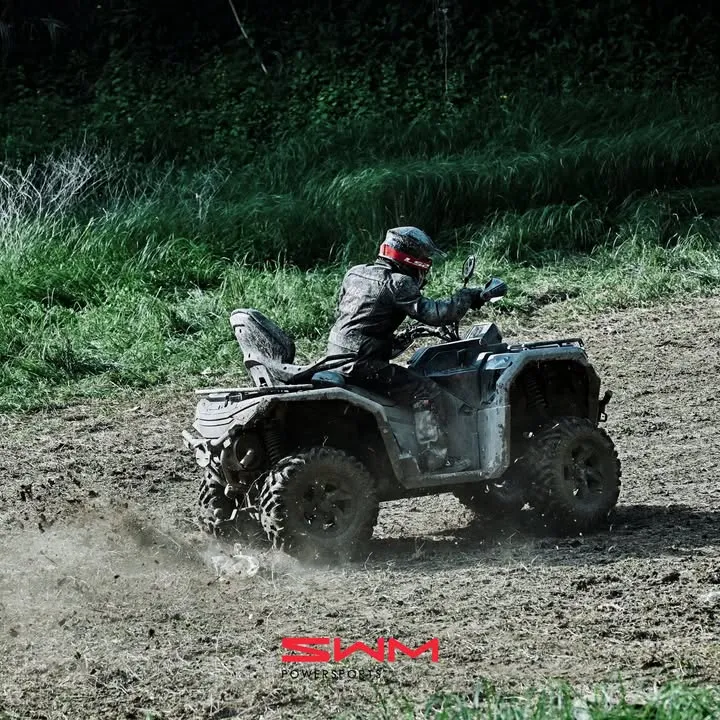
Most ATV rollovers don't happen to beginners with no riding experience. They happen to confident adults who have been driving cars for years — and who bring every wrong instinct with them onto the trail.
Understanding ATV weight shifting — is the single most important skill in off-road riding. Unlike a car, an ATV has no electronic stability system, no rollover prevention algorithm. The entire job of keeping four wheels on the ground falls on the rider's body position. Get it right, and challenging terrain becomes manageable. Get it wrong, and physics takes over within seconds.
This guide covers the five foundational ATV riding techniques that every rider should master before tackling hills, slopes, or fast corners.
Why Car Drivers Make the Most Dangerous ATV Beginners
Here's a counterintuitive truth: the rider most likely to flip an ATV isn't the nervous first-timer. It's the confident adult with ten years of driving experience.
Years behind the wheel of a car trains the brain to treat a vehicle as a passive, self-stabilizing machine. The safety net is mechanical — traction control, stability systems, and a cabin that insulates you from the physics happening underneath. On a car, your body is cargo. On an ATV, your body is the suspension.
This concept has a name: Body English. It refers to the deliberate, continuous shifting of a rider's weight and posture to control balance and traction. An ATV has no stability control and no roll-prevention system. Miss a weight shift at the wrong moment, and the machine goes where gravity sends it.
The five techniques below are not advanced skills. They are the baseline every rider should own before leaving flat ground.
Technique 1: ATV Hill Climbing — Forward Weight Transfer
The core rule: shift your weight forward, chest toward the handlebars.
During uphill riding on ATVs, gravity does not just act to retard the movement but also tries to turn the vehicle around its rear axle in the opposite direction. This results in the front wheels becoming airborne as soon as the center of mass of the rider shifts either sideways or backwards, and the vehicle falls over.
How to Position Your Body on a Climb
· Lean your chest toward the handlebars, shifting hips forward on the seat
· On grades steeper than 30°, you may need to be nearly lying flat against the fuel tank
· Keep your arms bent and active — rigid arms prevent you from pushing weight forward effectively
Stand on the pegs on very steep terrain to lower your center of gravity relative to the machine
Throttle Control on Hills
Body position alone isn't enough. Throttle discipline is equally critical. Apply power smoothly and consistently — sudden acceleration on a climb immediately shifts weight rearward and raises the front end.
The urge to "punch it" when momentum fades is one of the most dangerous reflexes a car driver brings to off-road riding. On a hill, a burst of throttle is not a solution. It is the cause of the rollover.
If the ATV begins to lose momentum mid-climb: Do not attempt to turn around on the slope. A grade change will immediately put your vehicle at risk of rolling over. Rather than changing gears, maintain your position using the brakes and then reverse yourself back down to the starting point.
Technique 2: ATV Downhill Riding — Engine Braking vs. Brake Pedal
The core rule: shift your weight back and use engine braking, not hard braking.
Descending reverses every principle from climbing. The force of gravity works on the front end of the vehicle, forcing the front wheels to take the load, thereby creating a risk for the front end of the vehicle to nose dive. It is up to the rider to counter this force by leaning his body backward.
What Is Engine Braking on an ATV?
Engine braking means engaging a low gear before the descent begins and letting the drivetrain resistance control your speed, rather than relying primarily on the brake pedal. This approach:
· Keeps all four wheels rotating with traction
· Preserves steering input throughout the descent
· Distributes deceleration force across the drivetrain rather than locking individual wheels
The brake pedal becomes a supplement — used lightly and intermittently — never stamped hard to the floor.
Why Hard Braking Is Dangerous on Descents
A locked front wheel on a descent loses steering entirely and plants the nose into the ground. The machine then rotates forward over the front axle. This is a front flip, and it happens in less than a second.
Prior to making your descent, be sure to scout your area first. Make note of the point at which the hillside evens out, take note of the area where the transition of the slope ends, and make sure that there will be enough of an even area for you to stop safely.
Technique 3: Traversing a Slope — Uphill Weight Shift
The core rule: push your weight toward the uphill side, not the downhill side.
Traversing — riding horizontally across a hillside — carries the highest lateral rollover risk of any common ATV maneuver. Gravity continuously pulls the machine toward the downhill side, and if the combined center of gravity crosses outside the uphill wheels, the ATV rolls sideways.
The Counterintuitive Move Most Riders Get Wrong
Facing a slope that drops away to the left, most new riders instinctively lean toward the valley — toward what feels like "down." This is the wrong response. The rider must actively push weight toward the uphill (higher) side to counteract the gravitational pull.
Here's how to do it correctly:
· Stand on the footpegs rather than sitting
· Press down firmly on the uphill footpeg
· Let the uphill knee push gently into the machine
· Keep your upper body shifted toward the high side
This repositions the combined center of gravity back over the vehicle's uphill contact patch, directly opposing the lateral force trying to tip the machine.
Slope Angle Guidelines for Traversing
Slope Angle | Recommended Action |
Under 20° | Traversable with correct weight shift |
20°–30° | Requires precise technique; choose the gentlest available line |
Over 30° | Reroute if possible; traverse only with strong experience |
Never steer mid-traverse. Any direction change shifts weight distribution unpredictably on a slope. If a course correction is needed, ride to a flat section first, reorient, then re-enter the slope.
Technique 4: ATV Cornering — The Outside Footpeg Technique
The core rule: weight the outside footpeg and lean your body toward the inside of the corner.
ATV cornering physics are closer to a motorcycle than a car. As the vehicle turns, centrifugal force pushes it toward the outside of the corner. To counterbalance this, the rider must create opposing force toward the inside — and the mechanism is the outside footpeg.
Step-by-Step ATV Corner Technique
1. Brake before the corner — complete all significant speed reduction before turning in
2. Weight the outside peg — press firmly down on the footpeg on the outside of the turn
3. Shift hips inward — use the outside peg as a pivot point to move your center of mass toward the corner's inside
4. Look at the exit — fix your gaze on where the corner straightens out, not the apex in front of you
5. Steady throttle through the apex — maintain consistent speed through the corner's tightest point
6. Accelerate out — apply progressive throttle as the corner opens up
The Most Common Cornering Mistake
Hard braking mid-corner is the ATV equivalent of stabbing the brakes in a car — amplified. Locked wheels on an ATV eliminate steering traction and send the vehicle straight off the outside of the turn. The car-driving reflex to brake when something feels too fast must be consciously overridden: slow down before the corner, not during it.
Technique 5: The Pre-Ride Mental Reset
The core rule: consciously unload your car-driving muscle memory before every ride.
The four techniques above are physical. This one is cognitive — and it may be the most important of all.
Experienced car drivers arrive at an ATV with deeply encoded reflexes that work against them:
· Sit back → on an ATV, this flips you over on a climb
· Use the brakes to slow down → on a descent, this pitches you forward
· Steer with your hands → on an ATV, your body steers as much as the handlebars
· Trust the vehicle to stay upright → an ATV has no self-stabilizing system
How to Build Correct ATV Muscle Memory
Find a flat, open area before riding any challenging terrain. Practice standing on the pegs while moving. Deliberately shift your weight forward, backward, and side to side, and observe how the machine responds to each shift. This is not a warmup — it is the process of building a new physical vocabulary.
When progressing to the trail, apply a deliberate difficulty ladder:
· Gentle slope before a steep one
· Shallow traverse before a significant hillside crossing
· Slow corner before a fast one
Each successful repetition at lower intensity deposits the correct movement pattern into long-term muscle memory, making it available as instinct when the terrain demands it.
One rule that never changes regardless of experience level: full protective gear, every single ride. Helmet, goggles, gloves, boots, knee and elbow protection. Body English prevents the majority of rollovers when applied correctly — but no technique eliminates all risk. The gear is the final margin.
Quick Reference: ATV Body Position by Terrain
Terrain | Weight Shift | Key Technique | Critical Don't |
Uphill climb | Forward — chest to bars | Smooth, steady throttle | Never punch the throttle |
Downhill descent | Rearward — hips back | Engine braking in low gear | Never hard-brake the front |
Slope traverse | Toward uphill side | Stand on pegs, press uphill peg | Never steer mid-traverse |
Corner | Toward inside | Weight outside peg, look at exit | Never brake mid-corner |
Flat/unknown terrain | Centered, standing on pegs | Active, responsive posture | Never ride sitting rigid |
-
Sep 30 2026
learn more
 First Buying ATV 10 Thing Need to Know
First Buying ATV 10 Thing Need to Know
First Buying ATV 10 Thing Need to Know
-
Sep 28 2026
learn more
 How to Prepare an ATV for Hunting Season
How to Prepare an ATV for Hunting Season
How to Prepare an ATV for Hunting Season
-
Sep 23 2026
learn more
 Best UTV Accessories for Hunting: Build the Right Hunting Setup
Best UTV Accessories for Hunting: Build the Right Hunting Setup
Best UTV Accessories for Hunting: Build the Right Hunting Setup
-
Sep 23 2026
learn more
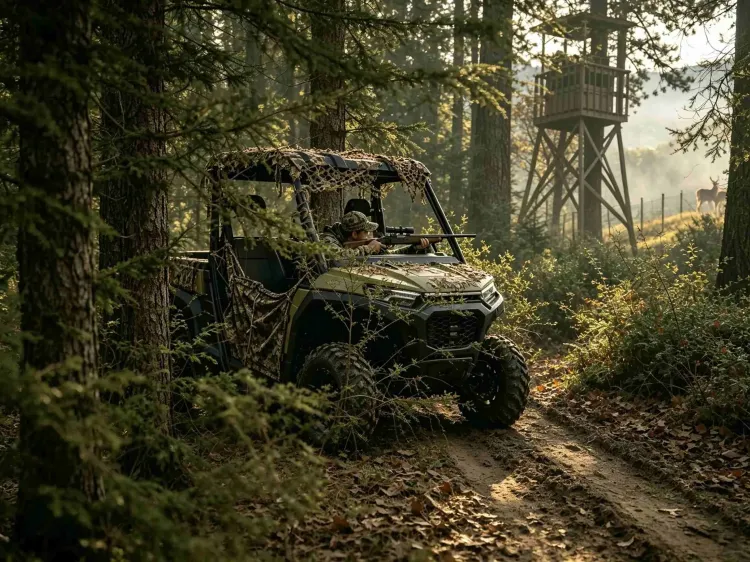 what is the best side by side utv for hunting?
what is the best side by side utv for hunting?
what is the best side by side utv for hunting?