ATV Tire Pressure: How to Check and Adjust It
Nov 02 2026
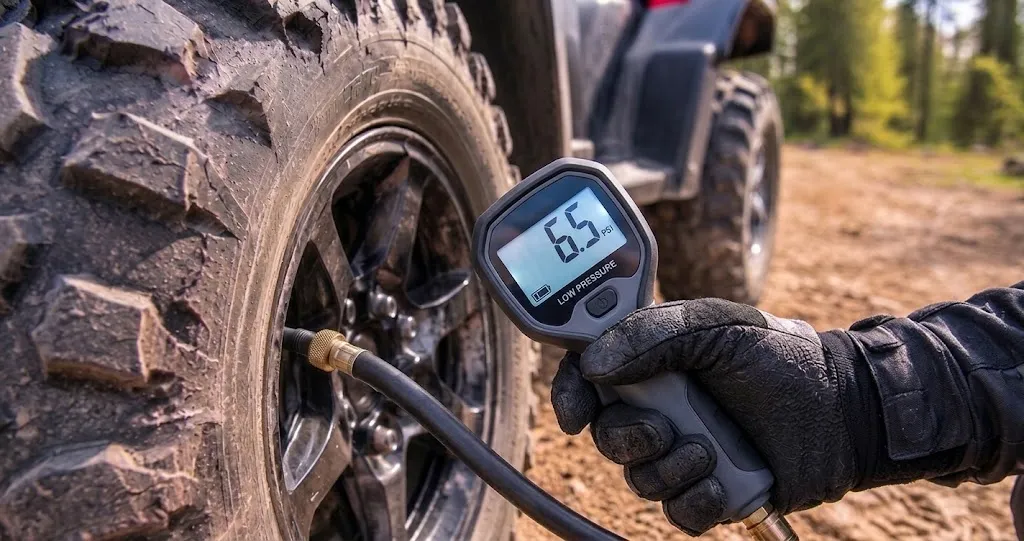
There is no single universal ATV tire pressure value that applies to all ATVs. The correct pressure depends entirely on the vehicle manufacturer’s official specifications, the tire’s specific size and construction, and the actual riding environment. When measuring tire pressure, always use a dedicated low-pressure tire pressure gauge and check the tires when they are completely cold. Knowing how to properly check and adjust tire pressure for ATV use not only significantly improves handling sensitivity and extends tire tread life, but is also a core requirement for safe off-road riding every time.
What Is the Correct ATV Tire Pressure?
Many new riders often make a common mistake when first getting involved with ATVs: they assume that ATV tire inflation standards are exactly the same as those for ordinary passenger car tires. However, ordinary car tires operate at higher road-going air pressures, while all-terrain vehicles (ATVs) use low-pressure tires.
Although ATV and UTV tire construction may look similar in appearance or tread pattern, the vehicle weight, tire size, and intended use of the two vehicle types are very different. Never apply the tire pressure standard of one vehicle category directly to another without checking the official specifications.
If you want to know how much air pressure in ATV tires is correct, or what pressure should ATV tires be, the first principle is to refer to the vehicle’s official technical documentation rather than generic reference values widely circulated online:
Manufacturer official specifications: Check your ATV Owner’s Manual, or inspect the tire pressure placard label attached to the vehicle frame (if equipped). The manufacturer’s specification is always your primary reference when determining the correct cold tire pressure value.
Axle and tire specification differences: Different ATV models, different tire tread designs, and different load distribution between the front and rear axles all mean that there is no single answer to what should ATV tire pressure be. It must be set according to the specific vehicle configuration.
Difference between cold tire pressure and hot tire pressure: When riding, the contact between the tires and the ground creates heat which causes the air inside to expand and the measured tire pressure to read higher. The PSI amount that is listed as the recommended amount is for cold inflation only—never blindly let air out after you have been riding and your tires are still hot.
Why Front and Rear ATV Tire Pressure Can Be Different
An ATV may require varied tire pressures in the front and rear wheels, different sizes, different construction designs, and varying load-carrying requirements. The front wheels are generally responsible for steering and the rear wheels give the drive force and traction significantly. They have distinct vehicle loads aswell. These design variances may influence the manufacturer’s suggested tire pressure numbers for the front and rear tires.
However, different front and rear tire sizes do not necessarily mean the tire pressures must be different. Some ATVs require the same pressure in all four tires, while other models specify separate front and rear tire pressures. When inflating tires in practice, always follow the vehicle owner’s manual or the tire pressure label on the vehicle body (if equipped). Do not assume on your own that the same value applies to all four tires.
In addition, tires on the left and right sides of the same axle should also maintain consistent tire pressure as required by the manufacturer. If there is a significant pressure difference between the left and right tires, it may affect vehicle handling and may even cause the ATV to drift to one side while riding.
How to Check ATV Tire Pressure with a Low-Pressure Gauge
The first and most important thing for accurate tire pressure readings is to choose the correct measurement instrument. The respected ATV Safety Institute says that riders should always utilise the tire pressure advised by the manufacturer and use a dedicated low pressure tire pressure tester to precisely check ATV tires. Standard car tire pressure gauges are ordinary and not built for the low pressure range utilised by ATVs and hence cannot be relied upon to give accurate low-pressure readings.
How to Choose the Right ATV Tire Pressure Gauge
Designed specifically for low-pressure ranges: an ATV low pressure tire gauge is perfectly suited to the lower operating pressures of ATV tires. Compared with tools designed mainly for high-pressure automotive tires, a dedicated low pressure tire gauge for ATV tires allows riders to easily obtain stable and trustworthy readings within the lower PSI range.
Choose a clear and appropriate scale range: when selecting an ATV tire pressure gauge, choose a product whose measuring range fully covers your ATV’s officially recommended tire pressure, and the scale markings must be clear and detailed so you can accurately read small air pressure changes.
Digital versus mechanical dial type: Digital display tire pressure gauges provide an easy to read and accurate digital readout, while conventional mechanical dial tire pressure gauges are quite rugged in tough outdoor off-road settings. Riders are allowed to choose according to their personal operating preferences.
How to Measure Tire Pressure Correctly
Ensure the tires are totally cold: check tire pressure after the car has been stopped and immobile for several hours, or before starting a fresh ride.
clear the valve stem: Before measurement, clear the mud and debris surrounding the valve stem to avoid the sand particles from sticking in the valve core or disrupting the seal between the tire pressure gauge and the valve stem.
Press vertically and read steadily: Press the low-pressure tire pressure gauge vertically and steadily against the valve stem, then properly read and record the PSI reading of each tire.
Check and record one by one: carefully record the actual readings of all four wheels. Before making any fine pressure adjustments, first compare and confirm consistency between the left and right sides of the same axle and the specification requirements for the front and rear axles.
Make regular tire pressure checks a normal item in your pre-ride inspection before every ride. At the same time, closely inspect tire tread deterioration, cuts or damage on the sidewalls and if wheel hub fasteners are tight.
ATV Tire Pressure Chart: How to Read and Use One
To help riders correctly understand and use the tire pressure chart provided by the manufacturer (ATV tire pressure chart), the table below summarizes the core fields usually included in such charts and their specific meanings:
Chart Field | Meaning and Purpose |
Front Tire PSI | Official recommended cold inflation pressure for the front tires |
Rear Tire PSI | Official recommended cold inflation pressure for the rear tires |
Tire Size | Tire size specification designated for each axle of the vehicle |
Cold Inflation Pressure | Target cold tire pressure that should be checked and reached before every ride |
Load Information | Maximum allowable vehicle load limit corresponding to a specific tire pressure setting |
An important point to note is that an ATV tire pressure chart can only be a technical reference for a given vehicle model and specified tire combination. This should never be used as a global guide to tire pressure. Make sure the parameters in the chart fit your exact ATV model and tire specs before attempting any fine adjustments to air pressure.
How to Adjust ATV Tire Pressure for Different Conditions
Caution should be exercised when altering tire pressure for varying off-road conditions. Don't sacrifice the overall construction of the tire or sacrifice protection for the wheel rim for momentary traction.
Hard-Packed Trails and Firm Ground
Do not just reduce the tire pressure when riding on compacted forest trails, hard dirt roads and gravel surfaces without reading the manufacturer’s guidelines. Under-inflated tires increase rolling resistance, increase tread wear, and dramatically increase the chance of tire puncture or wheel rim impact damage during high speed cornering or when passing over obstacles.
Sand and Soft Terrain
In soft sand terrain, appropriately lowering tire pressure can increase tire deformation and enlarge the contact patch, thereby improving the vehicle’s flotation and traction on sand to a certain extent. However, any pressure adjustment must be strictly kept within the limits permitted by the vehicle and tire manufacturers. Riders must never blindly assume that deflating tires is suitable for all ATVs or any tire combination.
Mud and Rocky Terrain
When riding on terrain that are muddy, tire pressure needs to be kept in the safe range known for the vehicle and tire combination. It is particularly crucial to maintain enough pressure on rough rocky terrain, as excessive deformation of the tires can weaken the sidewall and increase the risk of sharp rocks crushing and harming the tire or wheel rim significantly.
Common ATV Tire Pressure Mistakes to Avoid
In an effort to prolong the service life of tires and maintain the safety of off-road riding, pay attention to the following typical wrong operations in daily maintenance:
Using regular automotive tire pressure gauges: The measurement precision of regular automotive tire pressure gauges is generally insufficient in the low PSI range necessary for ATVs, which can easily lead to major miscalculations.
To inflate all four tires to the same pressure without verifying the specifications is to overlook variances in tire size or the load distribution requirements that the manufacturer sets for the front and back axles.
Measure the tire pressure soon after riding: if you measure with hot tires you’ll get a falsely high PSI reading and release regular air by mistake.
Relying entirely on the maximum pressure value printed on the tire sidewall: the maximum pressure (Max PSI) marked on the tire sidewall represents the tire’s ultimate pressure-bearing limit under maximum rated load. It must never be directly treated as your ATV’s daily recommended operating tire pressure. When checking compatibility, always use the vehicle manufacturer’s technical specifications as the standard.
Too much reduction in tire pressure for traction: Excessive deflation can cause the tire bead to lift off the edge of the wheel rim (bead unseating) under strong steering loads.
Not watching for gradual leaks/repeated pressure loss “If a tire keeps losing pressure and is associated with strange changes in handling it usually means that a tire may have been punctured, the sidewall may be damaged or there may be a mechanical fault that needs further, detailed inspection.”
How Often Should You Check ATV Tire Pressure?
You should carefully check your ATV tire pressure before every ride, especially if the vehicle has been sitting for a long period, there has been a large change in temperature, or if you have fitted new tires. Besides, when you feel odd handling feedback during riding, and suspect that the tire is under-inflated or leaking, it is also extremely vital to verify and confirm tire pressure after fine adjustment of pressure.
Final Thoughts
The correct tire pressure is not a fixed number that applies to all ATVs. It is a professional parameter determined jointly by the vehicle’s overall design, the tire’s specific specifications, and the actual riding environment. Developing the good habit of regularly checking with a dedicated low-pressure tire pressure gauge, accurately recording readings, and adjusting tire pressure strictly according to the manufacturer’s recommendations is the foundation for ensuring off-road safety and vehicle performance.
SWM offers multiple ATV models equipped with different tire configurations and technical specifications. Before every ride, be sure to consult the owner’s manual for your specific model to confirm the official recommended pressure most suitable for your vehicle and tire combination.
-
Nov 02 2026
learn more
 ATV Tire Pressure: How to Check and Adjust It
-
Nov 03 2026
learn more
 ATV Riding Tips for Beginners: Common Mistakes to Avoid
-
Oct 30 2026
learn more
 ATV Off-Season Storage Checklist: How to Prepare Your ATV for Long-Term Storage
-
Oct 28 2026
learn more
 Why Hybrid UTVs Are Changing Farm and Trail Riding in 2026?