Is Electronic Suspension Worth It for ATVs & UTVs?
Oct 08 2026
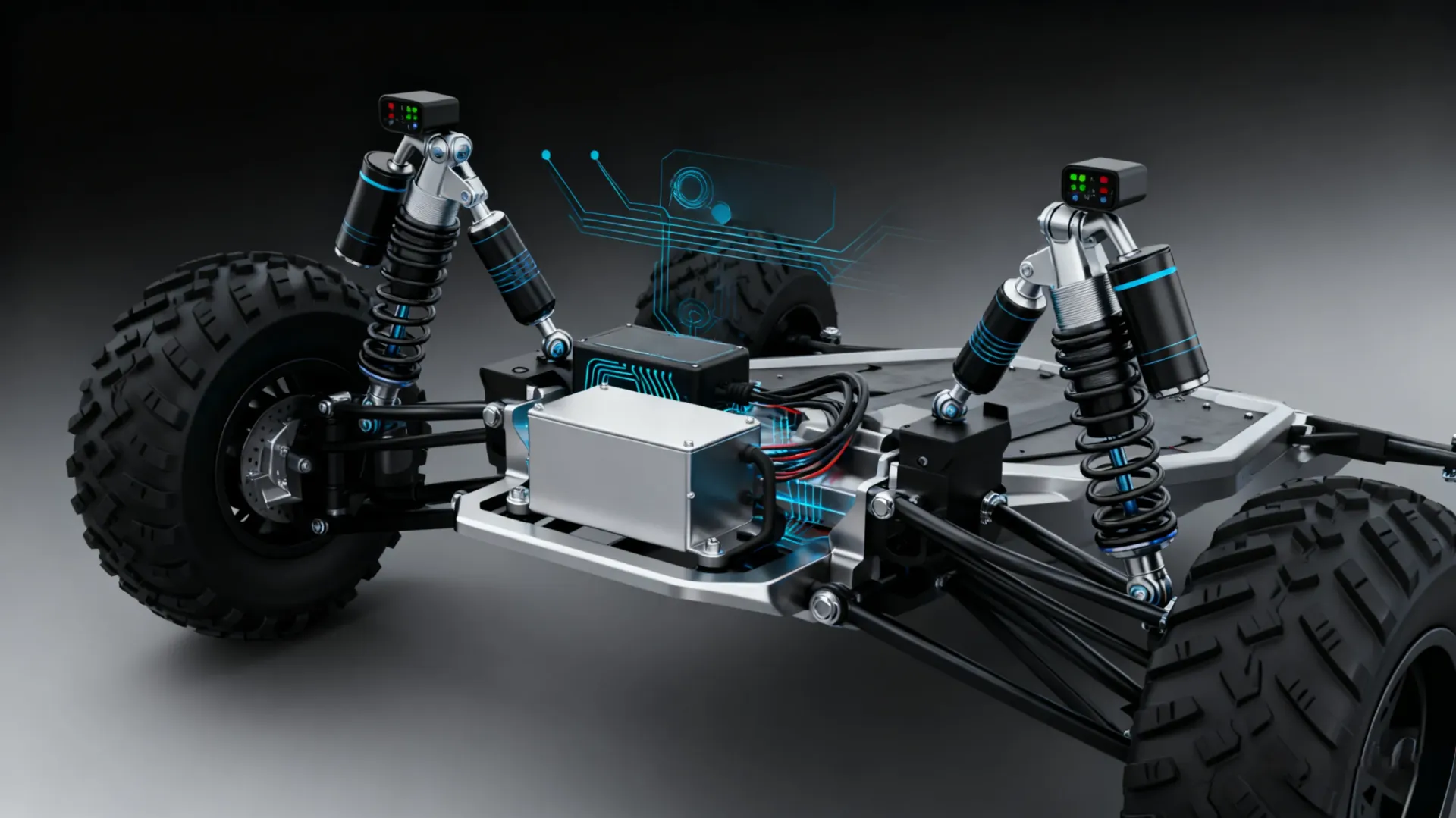
The suspension systems on traditional ATVs or UTVs often behave like someone with a "fixed personality": if set to be stiff, the ride becomes jarring on gravel; if set to be soft, the vehicle lacks sufficient support during high-speed cornering or upon landing. Riders are forced to compromise between comfort and performance.
Electronic suspension was introduced to solve this age-old problem. It allows the suspension to "think," adjusting damping in real-time based on road conditions so that the vehicle can balance comfort and support across various scenarios.
What Is Electronic Suspension?
In simple terms, the damping of traditional mechanical suspension is fixed (or it needs to be manually adjusted when the vehicle stops), while electronic suspension (also known as semi-active suspension) can change the softness or hardness of the shock absorber in real time during driving through sensors and electronic control systems.
It can be understood as:
Traditional suspension is like a pair of shoes with a fixed softness or hardness, while electronic suspension is like a pair of smart shoes that can automatically adjust the support force according to the road conditions. It uses sensors to sense the road conditions and the vehicle's posture, and then the control unit quickly adjusts the damping.
How Real-Time Damping Adjustment Works
Electronic suspension is not mysterious. Its working logic can be broken down into four steps:
1. Sensors collect information
Multiple sensors are installed on the vehicle body to monitor data such as wheel travel, impact speed, vehicle body tilt, and acceleration in real time. This is equivalent to equipping the vehicle with "eyes and ears".
2. The control unit quickly calculates
The computer (ECU) uses the data from the sensors to determine whether the current ride needs more softness for comfort or more rigidity for support.
3. Instant adjustment of damping
Through electromagnetic valves or motors, the flow speed of the oil inside the shock absorber is changed, making the suspension softer or harder. This process is usually completed in milliseconds.
4. Continuous dynamic optimization
The system repeats the above process continuously, up to hundreds of times per second, allowing the suspension to always match the current road conditions as closely as possible.
It should be noted that electronic suspension mainly regulates "damping" (the resistance of the shock absorber oil), rather than directly changing the softness or hardness of the spring. The spring still handles the weight of the vehicle body, while the electronic system controls the absorption of vibrations and the rebound speed.
Real-World Ride Improvements
The true value of electronic suspension lies in its "comprehensive performance" under various road conditions.
l High-speed rocky or washboard trails
Conventional shocks can transmit repeated impacts into the chassis. Real-time damping absorbs successive hits more effectively, reducing fatigue and keeping the vehicle more composed.
l Big whoops, jumps, and landings
The system can firm up quickly on compression, providing better support and reducing bottoming.
l Technical low-speed terrain
When needed, the suspension stays more compliant so the tires maintain better contact with rocks, roots, and uneven ground.
l Cornering and body control
Some systems independently adjust left and right dampers to reduce body roll, giving the rider more confidence in turns.
l Highway or smoother sections
The suspension can shift toward a more comfortable setting, reducing unnecessary harshness during long rides.
In summary, electronic suspension does not make the vehicle "softer" or "harder", but rather makes it soft when it should be soft and hard when it should be hard. It tries to resolve the contradictions that traditional suspension is unable to handle.
Electronic Suspension on Current Models
Across the industry, electronic suspension systems from many brands have been proven over multiple generations, demonstrating a mature balance between comfort and handling. They typically offer various riding modes (such as Comfort, Sport, and Work) that riders can switch between based on preference, with the system performing real-time fine-tuning on top of these settings.
In SWM POWERSPORT, the Trailhunter 1000 is equipped with Smart E-Suspension. This system focuses on optimizing two common pain points:
l On bumpy terrain, it adjusts damping to improve pitch control—minimizing the vehicle's fore-and-aft rocking motion—for a smoother ride.
l When cornering, it independently adjusts the left and right shock absorbers to enhance roll control, thereby improving cornering stability and rider confidence.
In terms of real-world feel, the Trailhunter 1000’s suspension moves beyond static, fixed settings; instead, it actively adapts to changing road conditions. It strikes a balance by maintaining sufficient support while offering greater comfort than traditional stiff suspension setups—making it particularly well-suited for riders who frequently transition between forest trails, mountainous terrain, and gravel paths.
Of course, the electronic suspension is an enhancement rather than a substitute for core engineering; it builds upon a solid chassis and suspension travel, complementing—but not replacing—sound mechanical design.
Is Electronic Suspension Worth It?
Good candidates for electronic suspension:
· Riders who frequently encounter mixed terrain (trails, rocks, gravel, light dunes)
· Those who value long-distance comfort and reduced fatigue
· Buyers with the budget for higher-spec models who want maximum versatility
Situations where it may be less critical:
· Mostly smooth forest roads or controlled environments
· Strict budget priorities focused on core reliability and value
· Experienced riders who prefer to manually tune conventional shocks
When shopping, evaluate the complete vehicle first — chassis, travel, power delivery, and build quality. Then consider electronic suspension as a meaningful upgrade for ride quality. On models like the Trailhunter 1000, Smart E-Suspension is positioned as a comfort and stability enhancement for riders who spend time on varied terrain.
Final Thoughts
Electronic suspension solves a long-standing problem in off-road vehicles: the difficulty of balancing comfort and support with a single fixed setup. The Smart E-Suspension on the SWM Trailhunter 1000, the core idea is the same — a suspension that reads the trail and responds in real time.
It is not magic, and it is not essential for every rider. But for those who ride diverse terrain and want a more refined experience, modern electronic suspension delivers a clear and noticeable improvement in both comfort and control.
Have you tried a vehicle with semi-active or electronic suspension? Share your experience in the comments. If you are considering a model equipped with this technology, exploring the Trailhunter 1000 or similar equipped machines is a good next step.
Ride safe and enjoy the trail.
-
Oct 08 2026
learn more
 ATV Engine Knocking Noise: Causes and What to Check
ATV Engine Knocking Noise: Causes and What to Check
ATV Engine Knocking Noise: Causes and What to Check
-
Oct 08 2026
learn more
 Is Electronic Suspension Worth It for ATVs & UTVs?
Is Electronic Suspension Worth It for ATVs & UTVs?
Is Electronic Suspension Worth It for ATVs & UTVs?
-
Oct 07 2026
learn more
 UTV Suspension: Types, Travel, and How It Works
UTV Suspension: Types, Travel, and How It Works
UTV Suspension: Types, Travel, and How It Works
-
Sep 30 2026
learn more
 First Buying ATV 10 Thing Need to Know
First Buying ATV 10 Thing Need to Know
First Buying ATV 10 Thing Need to Know