UTV Suspension: Types, Travel, and How It Works
Oct 07 2026
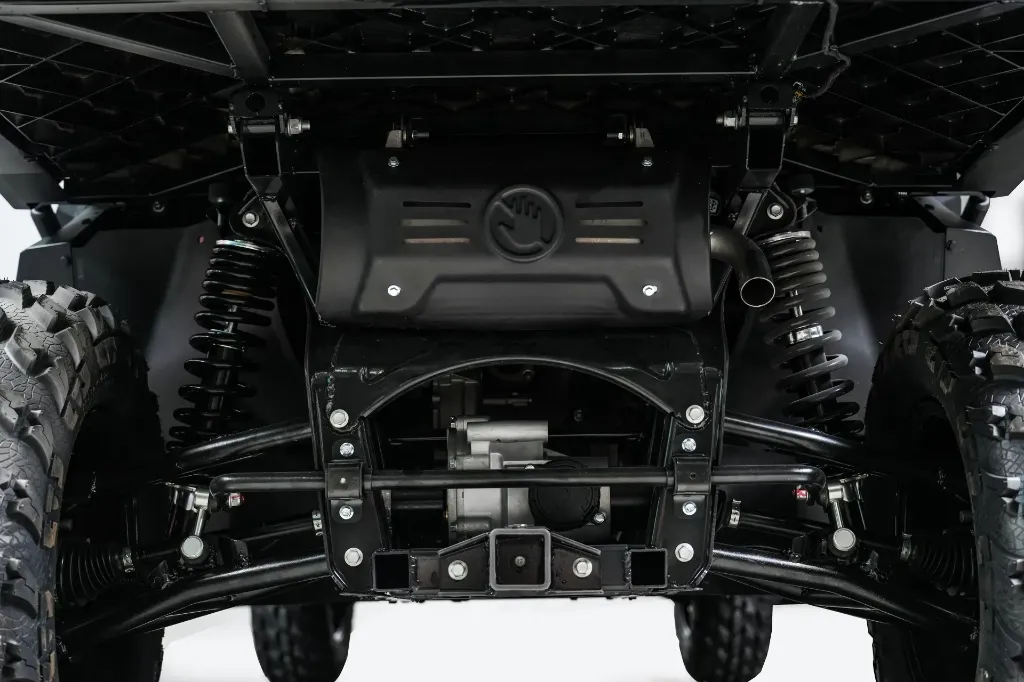
UTV suspension is what ties the wheels to the frame. It gives them room to move up and down as the ground changes, while also keeping the impact on the body—and the suspension movement itself—under control.
If you ride a UTV through mud, gravel roads, forest trails, or other rough ground a lot, the suspension is one of the first things you’ll notice. It changes how the vehicle handles uneven surfaces, how stable it feels, and how comfortable the ride is.
Even so, one spec won’t tell you much about a UTV suspension. You still need to look at the suspension structure, travel, shock absorbers, and the overall vehicle design together.
This guide starts with how a UTV suspension system works. Then it covers common suspension types, suspension travel, what shock absorbers do, and the specs worth comparing when you choose.
How Does a UTV Suspension System Work?
At its core, UTV suspension gives the wheels room to move relative to the body while the vehicle is driving.
When the wheels hit bumps, potholes, or other uneven ground, the suspension lets them move. Springs and shock absorbers then manage that motion, so the body doesn’t rise and fall by the same amount every time a wheel moves.
Simply put, a complete UTV suspension system mainly needs to solve two problems:
l Allow the wheels to adapt to uneven terrain;
l Control the movement between the wheels and the body.
Therefore, the suspension system is not determined by a single component alone, but is the result of multiple components working together.
What Are the Main Parts of a UTV Suspension?
Specific structures may vary between different UTVs, but common suspension parts include:
l Control arms: Used to connect the wheel assembly to the vehicle frame and control the wheel’s motion path.
l Springs: They hold up part of the vehicle’s weight and let the suspension compress and rebound when it takes a hit.
l Shock absorbers: They control how fast the suspension moves and keep the springs from compressing and rebounding over and over at high speed.
l Anti-roll bars: Some vehicles use an anti-roll bar to help keep body roll in check.
These parts need to work together, so looking at only one part is usually not enough to judge the performance of the entire suspension.
What Are the Main Types of UTV Suspension?
UTVs do not use only one type of suspension structure. Understanding different structures helps explain why vehicles adopt different suspension layouts.
Independent Suspension
The characteristic of independent suspension is that the movement of each wheel is not completely directly limited by the movement of the wheel on the other side of the same axle.
When one wheel encounters a bump, that wheel can have its own suspension movement, while the other wheel can remain in a relatively independent state of movement.
This structure is common on off-road vehicles that need to handle uneven terrain, because the left and right wheels can move according to the terrain each one contacts.
However, independent suspension is only a structural concept. Actual performance is also affected by suspension geometry, travel, shock absorbers, and overall vehicle design.
Double A-Arm Suspension
Double A-arm suspension is a common independent suspension structure in UTVs.
It usually connects the wheel assembly to the frame through upper and lower control arms. The two control arms resemble the letter “A” when viewed from the side of the vehicle, so they are called A-arms.
This structure can help design the vehicle’s wheel motion path and provide a relatively clear structural layout for the suspension system.
But note that using Double A-arm suspension does not mean all vehicles have the same suspension performance. When comparing vehicles, you should further check suspension travel, shock absorbers, and other chassis specifications.
What Is UTV Suspension Travel?
UTV suspension travel refers to the distance the wheels can move up and down within the range allowed by the suspension system.
For example, if a vehicle’s front suspension is listed as 10 inches of travel, it means the front wheel suspension system has a nominal range of motion of 10 inches.
Suspension travel is especially worth attention for off-road vehicles, because when driving on uneven ground, the wheels need to constantly move up and down with the terrain.
However, more suspension travel does not necessarily mean better.
Actual performance is also related to suspension geometry, shock absorbers, vehicle weight, tires, and the vehicle’s intended use. Therefore, when comparing UTVs, you cannot judge only by the suspension travel number.
Why Does Suspension Travel Matter on a UTV?
The significance of suspension travel is mainly reflected in the range of wheel movement when dealing with terrain changes.
Wheel Movement Over Uneven Terrain
When a UTV passes over potholes, rocks, or other ground with obvious height changes, the wheels need to move up and down to adapt to the terrain.
If the suspension has enough range of motion, the wheels can continue moving within the range allowed by the suspension system, rather than quickly reaching the suspension’s limit.
Therefore, suspension travel is a parameter worth paying attention to when judging a UTV’s off-road suspension design.
Maintaining Tire Contact
Contact between the wheels and the ground is very important for a vehicle passing over uneven terrain.
When the wheels can move with terrain changes through suspension motion, it is easier to maintain contact with the ground.
But here too, you cannot simply equate “more suspension travel” with “stronger grip.” Tires, suspension geometry, vehicle weight, and shock absorber control all affect the final performance.
Ride Comfort and Control
The suspension also absorbs and manages impacts from the road.
When the vehicle runs over one bump after another, the right amount of suspension movement can keep some of that impact from going straight into the body and the people inside.
At the same time, the suspension still has to control wheel movement. It can’t let the body and wheels bounce up and down without any control. The main job of UTV shock absorbers is to control suspension movement.
How Do Shock Absorbers Affect UTV Suspension?
The main role of UTV shock absorbers is to control the movement of the suspension system.
Springs can store and release energy. But if there isn’t enough motion control, the suspension may keep compressing and rebounding quickly after an impact.
Shock absorbers manage that movement, so compression and rebound stay under control. Shock absorbers control suspension movement.
Together, they decide how the suspension system reacts when the road changes.
Therefore, when comparing UTV suspension, you should not only look at suspension type and travel. You should also pay attention to what type of shock absorbers the vehicle uses.
Simply put:
l Suspension travel determines how much range the wheels can move;
l Springs support and store energy;
l Shock absorbers control suspension movement.
How Should You Choose a UTV Suspension?
As you choose UTV suspension, be sure to consider where the vehicle will be utilized most often.
Different uses do not necessarily require exactly the same suspension setup.
For Work and Utility Use
If you are mostly going to use your UTV for work or daily utility, you can focus on the overall stability of the vehicle, the suspension construction, the suspension travel, and the vehicle's flexibility in the actual work environment.
If the vehicle regularly travels on uneven worksites, it must be able to cope with constant road changes. So, the suspension system should be able to cope with it.
Therefore, rather than looking for the biggest suspension travel separately, it is advisable to do a holistic comparison of suspension structures, shock absorbers and overall vehicle specs.
For Trail Riding
If it is mainly used for trail riding, you can focus on comparing suspension travel, suspension structure, shock absorbers, and vehicle ground clearance.
Forest trails, gravel roads, and continuously undulating ground usually cause frequent suspension movement, so the overall design of the suspension system is more important than a single number.
For Rough Terrain
If you often face more complex off-road terrain, you can focus on suspension travel, ground clearance, tire specifications, and overall vehicle chassis design when comparing the overall size and capability of a UTV.
Especially on uneven terrain, suspension is only part of the vehicle’s capability. Tires, drive system, and vehicle dimensions also need to be considered.
UTV Suspension Specifications to Compare
When comparing different UTVs, you can prioritize checking the following suspension-related specifications:
l Suspension type: Understand what kind of suspension structure the vehicle uses.
l Suspension travel: Understand how much range of suspension movement the wheels can have.
l Shock absorber: Understand what type of shock absorbers the vehicle uses.
l Ground clearance: Understand the space between the bottom of the body and the ground.
l Tire size: Compare as part of the vehicle’s overall off-road configuration.
The most important thing is not to look at only one number.
For example, two UTVs both using Double A-arm suspension does not mean their suspension performance is exactly the same; similarly, a vehicle with more suspension travel is not necessarily suitable for all use scenarios.
SWM UTV Suspension: What the Nomader Line Offers
SWM has published specific suspension structures, suspension travel, and shock absorber specifications for different models and configurations, so these parameters can be directly used for basic comparison between models.
SWM Model | Front Suspension | Rear Suspension | Shock Absorber |
Nomader 720 | Double A-arm, 10 in. (254 mm) | Double A-arm, 10 in. (254 mm) | Oil shock absorber |
Nomader 850 | Double A-arm, 10.6 in. (270 mm) | Double A-arm, 10.2 in. (260 mm) | Oil shock absorber |
Nomader 1000 PRO | Double A-arm, 10.6 in. (270 mm) | Double A-arm, 10.2 in. (260 mm) | Oil shock absorber |
Nomader Hybrid Pro | Double A-arm, 9.5 in. (241 mm) | Double A-arm, 9 in. (231 mm) | Oil shock absorber |
If you need to further compare different models, you can directly view the complete SWM SXS models and check the officially published suspension parameters according to the specific model and configuration, rather than judging only by the model name.
Final Thoughts
The role of UTV suspension is not just to make the vehicle “softer” or “more comfortable.”
A complete suspension system needs to allow the wheels to adapt to the terrain while controlling the movement between the wheels and the body through springs, shock absorbers, and suspension structure.
Therefore, when comparing UTV suspension, you can understand it on three levels:
First look at the suspension structure, such as Double A-arm suspension;
Then look at suspension travel to understand how much range the wheels can move;
Finally, combine shock absorbers, ground clearance, tires, and overall vehicle design for judgment.
For actual vehicle selection, the most suitable suspension is not necessarily the one with the largest specifications, but should match the vehicle’s use environment and purpose.
SWM provides official suspension parameters for different models and configurations, so you can further compare according to the specific model’s suspension type, travel, and shock absorber specifications.
-
Oct 08 2026
learn more
 ATV Engine Knocking Noise: Causes and What to Check
ATV Engine Knocking Noise: Causes and What to Check
ATV Engine Knocking Noise: Causes and What to Check
-
Oct 08 2026
learn more
 Is Electronic Suspension Worth It for ATVs & UTVs?
Is Electronic Suspension Worth It for ATVs & UTVs?
Is Electronic Suspension Worth It for ATVs & UTVs?
-
Oct 07 2026
learn more
 UTV Suspension: Types, Travel, and How It Works
UTV Suspension: Types, Travel, and How It Works
UTV Suspension: Types, Travel, and How It Works
-
Sep 30 2026
learn more
 First Buying ATV 10 Thing Need to Know
First Buying ATV 10 Thing Need to Know
First Buying ATV 10 Thing Need to Know