ATV vs UTV for Snow Plowing: 5 Key Differences
Oct 20 2026
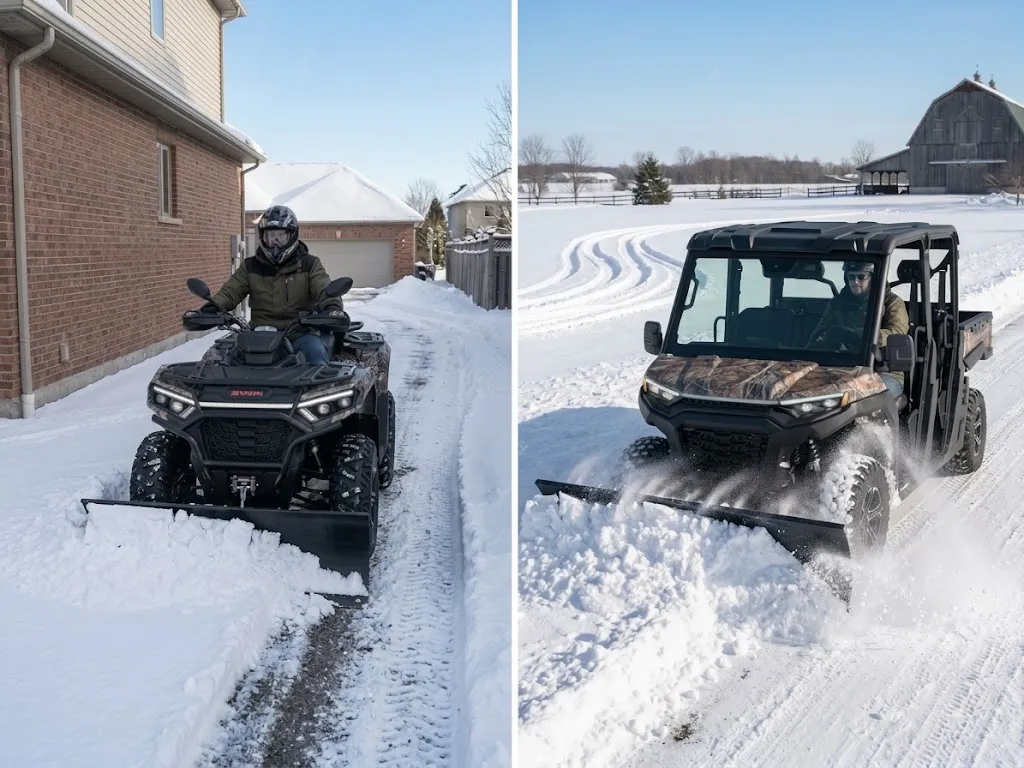
When it comes to atv vs utv for snow plowing, the choice usually depends on how much ground you need to clear, what kind of snow you get, how tight the space is, how long you’ll be out, and what your vehicle and plow can handle. ATVs tend to work well in tight spots where you’re turning constantly. UTVs make more sense on wider driveways, bigger properties, and jobs that keep you out for hours. That said, real-world results still hinge on the exact model, tire grip, drive system, and snow conditions.
5 Key Differences Between ATV And UTV For Snow Plowing
Vehicle size, design, and intended use all affect how well snow-removal equipment works in different situations. Here’s a quick comparison of five fundamental differences between ATVs and UTVs for snow plowing:
Comparison Item (Characteristic) | ATV (All-Terrain Vehicle) | UTV (Utility Terrain Vehicle / Side-by-Side) |
Maneuverability | Smaller and easier to handle in tight areas with lots of turns | Wider body, so it needs more room to turn and steer |
Workload / Coverage | A better fit for smaller jobs, though results depend on setup and plow match | Can be more practical for wider driveways and larger properties; actual coverage depends on configuration |
Power / Drive / Traction | Traction varies by model, tires, drive system, and snow; you can’t judge it by category alone | Same here—model, tires, drive system, and snow all matter, so vehicle type alone won’t tell you much |
Operator Comfort | Subjected to cold weather when riding in the open air | Usually provides a side-by-side sitting arrangement, some variants can be fitted with enclosed cab protection |
Cost | Some models may be a reduced initial cost alternative but upkeep and increasing costs also need to be considered | The price of the vehicle and its associated plow and lift accessories can be more expensive. |
Note: The purpose of comparing the two types of vehicles is to analyse their properties in different settings, not to assess absolute superiority. The actual selection must verify the load capacity of the particular model, the authorised attachment combinations, and the manufacturer constraints.
What type of vehicle is best for your snow removal work?
Once you understand the basic characteristics, the selection of the vehicle to use will depend primarily on the unique location and working environment to be cleaned.
Narrow Roads and Small Driveways
An ATV’s smaller size may allow for more flexible operating on narrow driveways, walkways, garden paths and situations where you need to reverse and turn frequently. UTVs can also be employed in these situations, but you will need to check the body width, the turning space available and the size of the plow. Evaluate the entire snow removal system before determining if a vehicle will do the job. This includes the drive system, tires, plow blade and mounting brackets to ensure the entire system is a good match.
Spacious Estates with Long Driveways
A UTV may be the better choice for broader driveways and larger properties especially if its seats, cargo bed and optional plow arrangement match the task. Actual clearing performance varies on the individual vehicle, traction, blade breadth, snow conditions and available turning space.
Deep, wet or packed snow
When dealing with deep snow, wet snow, or compacted snow, don't just estimate the job difficulty by snow depth:
Snow conditions:
Wet snow and compacted snow enhance resistance to plowing and make greater demands on vehicle traction and equipment construction.
Vehicle-plow match:
Actual capability depends on the width of the plow, kind of mounting, and manufacturer usage limits.
Ground conditions:
Traction Ice, slopes and soft ground can affect traction. Four wheel drive helps to split power but does not mean the vehicle will never skid.
Method of working:
Use the vehicle handbook and plow manufacturer recommendations to control amount of snow pushed each time Clear in batches Do not overload vehicle over its load limit.
What Matters Most to Snow Plowing Performance
Besides the kind of the vehicle, the real effectiveness of Your snow removal in the winter is directly determined by the following major technical criteria.
Tires and Four-Wheel Drive
Four-wheel drive helps distribute drive force properly under the right conditions, but cannot eliminate the risk of slipping on ice or other low-traction terrain. Traction is affected by tyre tread and tyre pressure and ground conditions and vehicle weight. Tire construction and load capability are also crucial because the difference between ATV and UTV tires comes down to how tires are really constructed to sustain the vehicle and manage heavy loads. If you are thinking of optional tracks as an addition, check in advance whether the model in question can accommodate them; it cannot be generally said that tracks are always better than correctly selected tires.
Engine power, size and weight of Plow
Engine power is one of the factors in snow removal capability. Larger displacement does not necessarily guarantee better snow removal performance . The vehicle weight, tire traction, drive arrangement, plow breadth and snow resistance must be evaluated together. A too wide plow will substantially increase the resistance for plowing and may not be suitable for all models. UTV snow-plowing capability varies on traction, snow density, plow blade design and terrain conditions, considering plowing load. Manufacturer’s specifications for the installation and use of a particular plow on a vehicle should be strictly adhered to.
Before You Pick Up Your Vehicle, Check The Snow Plow
When you buy snow removal equipment, the characteristics of the snow plow itself and the model compatibility are just as crucial as the vehicle.
Make Sure The Plow Matches Your Exact Model.
"Don't just think any plow is good because it says "for ATV" or "for UTV." You are required to carefully check the exact model, production year, mounting brackets, permissible blade size and manufacturer-specified usage limitations. Professional buying guides are a great way to get an understanding of plow structure kinds and selection points, but precise fitting has to be checked by the official compatibility confirmation for the individual vehicle.
Select The Correct Blade & Lift System
Straight or V-Plows:
Different blade types fit different pushing and stacking ways depending on actual snow conditions, task needs and the manufacturer’s design architecture.
Polyethylene (Poly) vs. Steel:
Choose carefully for material properties, structural strength, durability, corrosion resistance, maintenance requirements, and product design.
Lift control systems:
Manual lift, winch lift and hydraulic lift methods differ in ease of use, structural complexity and battery load needs. Consider them against frequency of use and vehicle compatibility.
Mounting brackets & ground clearance:
Check to see if the underbody mounting bracket is tightly mounted and if it will impair the everyday ground clearance and regular use of the vehicle during the non-snow season.
After snow removal operations, immediately remove snow, ice and road de-icing salt residue from the vehicle and plow, and perform routine inspections and maintenance in accordance with the specifications of the vehicle and accessory manufacturers.
How to Make the Final Decision
To summarise, the right decision on snow removal solution needs to evaluate the following comprehensively:
Narrow areas: Think about vehicle size, turning radius, and operation space.
Large properties: Also look at vehicle configuration, plow width and operator comfort and extended hours of labour requirements in depth.
Difficult snow conditions: Be sure to check the real compatibility of the vehicle-plow, tire or track traction and manufacturer’s stated safe usage restrictions.
The best ATV vs UTV for snow plowing option depends on the region you clear, the snow you face, and the equipment your particular vehicle can safely handle.
Conclusion: ATV vs UTV for Snow Plowing
Choosing the proper one is not about finding a "absolutely perfect" model, but about finding the solution that best fits your working environment, terrain requirements and budget. Whether you’re working in tight, small yard paths or expansive properties with complicated snow conditions, knowing your vehicle’s specs, traction performance and plow accessory compatibility is vital to safe, effective winter work.
SWM, a producer and service supplier to the powersports industry, continues its R&D and manufacturing of all-terrain vehicles (ATVs) and utility terrain vehicles (SxS/UTVs). With reliable chassis architecture, strict quality system and vehicle platforms for multiple scenarios, SWM offers high-quality vehicle choices and professional service support for various needs such as winter multi-purpose work, agricultural and forestry work, outdoor off-road use, etc.
The ideal ATV versus UTV for snow plowing relies on the area you clear, the snow you plow and the equipment your particular vehicle can safely support.
-
Oct 20 2026
learn more
 ATV vs UTV for Snow Plowing: 5 Key Differences
-
Oct 19 2026
learn more
 ATV Advantages: 7 Benefits Every Buyer Should Know
-
Oct 15 2026
learn more
 How UTVs Make Everyday Ranch Work Faster & Easier
-
Oct 14 2026
learn more
 What's the Difference Between an ATV and a UTV?