How to Choose the Right ATV Engine Size in 2026: Work, Play, or Both?
Jun 02 2026
Buying an ATV without understanding displacement is like hiring an employee without checking the job description. Too small, and you're asking a compact car to haul a trailer. Too large, and you're paying a premium for power you'll never safely use — or need.
If you are cutting fence lines in a 50-acre field, hunting for elk in pine forests, or applying roost on the sand dunes over the weekends, having the right engine size becomes crucial because of the implications it will have on your enjoyment.
This guide cuts through the marketing noise. We break down every major displacement class — 300cc to 450cc, 500cc to 750cc, and 800cc and above — against the real-world scenarios where each one either shines or struggles.
The Real Cost of Getting ATV Displacement Wrong
A mismatched ATV doesn't just underperform — it costs you money in three directions at once.
⚠ Too small: You overheat the engine pushing loads beyond its rating, burn through belts and clutch components ahead of schedule, and eventually face a repair bill that dwarfs what upgrading would have cost you upfront. A 300cc machine struggling to pull a loaded utility trailer is a machine ageing fast.
⚠ Too large: You're absorbing higher sticker prices, heavier fuel bills, elevated insurance premiums, and the very real physical challenge of managing a 650+ lb machine in tight wooded terrain or soft agricultural ground. Beginners often find that more displacement means less confidence — and less time in the seat.
The sweet spot is different for everyone. A cattle rancher checking water tanks daily has completely different displacement needs than a weekend dune rider or a first-time buyer doing property management. The goal of this guide is to help you find your own sweet spot — and buy once, buy right.
300cc–450cc ATVs: The Practical Everyday Workhorse
Small doesn't mean weak. The displacement of the 300cc – 450cc range has been developed purely for smooth utilitarian use and for those who are learning their off-road skills. These machines serve the best purposes for farming and managing properties in addition to leisure riding where nimbleness counts over power.
Who Should Buy a 300cc–450cc ATV?
This displacement range is the right choice if your checklist looks like this:
• You manage 5–50 acres of land — spraying, mowing, hauling feed, or checking fences
• You're a first-time ATV owner who wants to build rider confidence before scaling up
• You primarily ride established trails rather than technical, rocky, or extreme terrain
• Budget matters: you need a capable machine under $7,000–$9,000 new
• You value fuel economy and lower running costs over headline horsepower figures
• Youth or smaller-framed riders who need a manageable power-to-weight ratio
Brands like Honda, Yamaha, and Can-Am all offer well-regarded models in this tier. The Honda FourTrax Rancher (420cc) and Yamaha Grizzly 350 are perennial benchmarks for reliability and residual value.
Pros and Cons of Small-Displacement ATVs
✔ Advantages
• Lower purchase price — typically $4,500–$9,000 depending on brand and spec
• Better fuel economy — 35–50% less fuel consumption than 700cc+ equivalents
• Lighter overall weight — easier to load, trailer, and extract from soft ground
• Lower insurance and registration costs in most regions
• Simpler maintenance — fewer complex electronic systems, lower labour costs
✖ Limitations
• Towing capacity maxes around 800–1,100 lbs — inadequate for heavy implement work
• Power falls short on steep grades when loaded with gear or pulling attachments
• Limited suspension travel on most entry-tier models reduces rough terrain comfort
• Not competitive for riders who want to progress into technical off-roading
500cc–750cc ATVs: The Sweet Spot for Most Riders
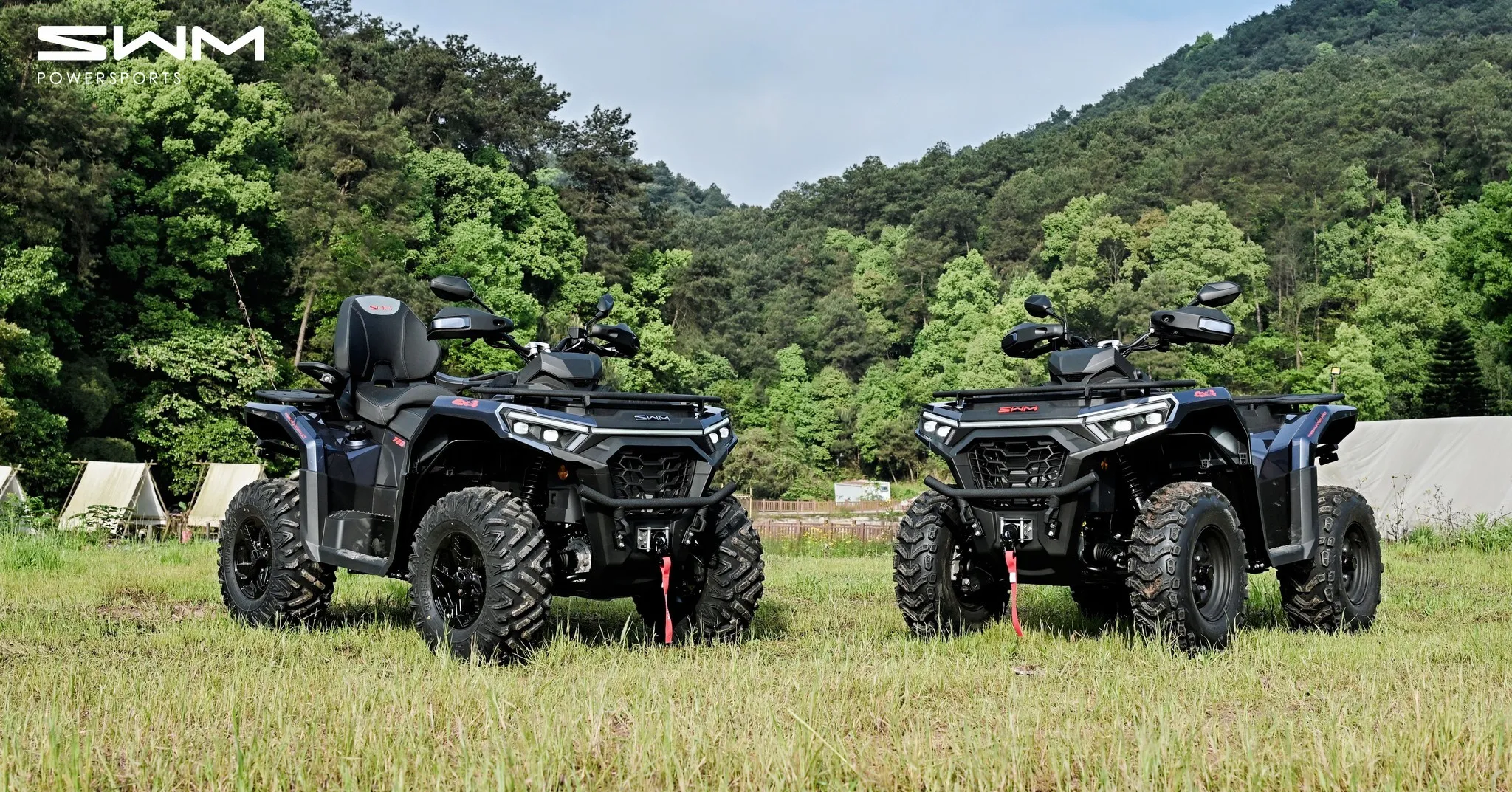
While the 300–450cc category represents the practical compact car, the 500-750cc range is the larger pickup truck which, like the compact class, manages to combine utility and sportiness while being able to fill both purposes with the same machine. This is the category most experienced buyers land in — and with good reason.
Heavy-Duty Work Without the Heavyweight Price Tag
The jump from 450cc to 500cc+ brings a meaningful torque increase that transforms work capability. In this displacement band, you get:
• Towing capacity of 1,200–1,700 lbs — adequate for box blade grading, livestock trailers, and heavy sprayer units
• Payload ratings of 200–400 lbs — practical for carrying fencing materials, tools, or harvested game
• Low-range gearing on most models, critical for slow-speed precision on slopes and muddy paddocks
• Higher-spec suspension with longer travel, absorbing ruts and rough ground with significantly less rider fatigue
For mixed-use buyers — those who need genuine work capability Monday through Friday but want an engaging trail ride on weekends — the 500cc–750cc window offers the best cost-per-use value in the market.
Trail Riding and Moderate Off-Road Performance
Beyond the work site, 500–750cc ATVs genuinely hold their own on intermediate trails. Power-to-weight ratios in this class produce a ride character that rewards skilled inputs without punishing mistakes — a balance that's hard to find in either the budget or ultra-performance tiers.
Ideal riding scenarios:
• Hunting access routes — enough power to carry full gear loads over uneven terrain without overheating
• Forest and fire road trails — responsive enough for technical sections, stable enough for long-distance rides
• Light mud and creek crossings — snorkelled models and proper tyres handle seasonal conditions well
• Multi-day backcountry exploration — fuel range and comfort make extended trips practical
Buyers in this segment should compare CVT vs manual transmission options carefully. Manual gearboxes offer better engine braking on descents; CVT units simplify operation for occasional riders or those doing repetitive utility tasks.
800cc+ ATVs: Built for Riders Who Refuse Limits
The 800cc-and-above segment is unambiguous about its priorities. These machines are engineered for maximum displacement, maximum traction, and maximum adrenaline. They are not utility vehicles that happen to be powerful — they are performance platforms that happen to carry a rack.
Extreme Terrain, Maximum Output
What makes the above 800cc class different from all other classes is the torque generation of the engine when operating at low RPM, which enables the motorcycle to pull itself out of axle deep mud, sand, and even climb uphill tracks.
Where big-bore ATVs excel:
• Deep mud riding — sustained low-speed torque prevents stalling when traction drops suddenly
• Sand dune riding — high horsepower figures translate directly to dune climbing ability and flat-out speed
• Rocky technical terrain — larger engines generate enough grunt to creep over boulder fields without revving hard
• Competitive riding — GNCC, WORCS, and other organised series are dominated by 700cc+ machinery
• Towing in extreme conditions — the reserve power margin makes a genuine difference when terrain works against you
The Polaris Sportsman 850 Trail, Can-Am Outlander 1000R, and Yamaha Grizzly 700 EPS represent three distinct philosophies in this displacement range — utility-biased, sport-biased, and a genuine middle ground respectively.
The Drawbacks of Going Big
Serious power comes with serious trade-offs. Before committing to an 800cc+ platform, evaluate these honestly:
• Purchase price typically ranges $12,000–$18,000+ new, with premium EPS models exceeding $20,000
• Fuel consumption increases significantly — expect 35–50% higher operating costs per km vs mid-size equivalents
• Machine weight of 650–800+ lbs creates real challenges in soft terrain recovery, loading, and transport
• Skill requirement is genuine — high-torque machines are unforgiving of rider error in technical situations
• Maintenance intervals and parts costs are higher across the board; budget accordingly for annual service
• Overkill on managed agricultural land — the extra displacement adds cost without adding useful capability for most farm applications
2026 ATV Displacement Comparison
Use the table below to compare each displacement class at a glance. Click any row in your mind — then scroll to the relevant section above for the full picture.
Displacement | Best For | Towing Capacity | Rider Level | Fuel Economy |
300cc–450cc | Light farm, yard, beginner, trails | 800–1,100 lbs | Beginner–Intermediate | ★★★★★ |
500cc–750cc | Mixed work & recreation, hunting | 1,200–1,700 lbs | Intermediate | ★★★☆☆ |
800cc+ | Extreme terrain, mud, sand dunes | 1,500–2,000 lbs | Experienced | ★★☆☆☆ |
Match Your ATV to Your Life — Built by SWM
You've read the guide. You know your terrain, your workload, and what kind of rider you are. Now it comes down to a single decision: how much displacement does your life actually demand? SWM has engineered two answers — and between them, they cover every scenario this guide has described.
SWM TrailHunter 720 — 650cc | The Sweet Spot, Perfected
The TrailHunter 720 sits precisely in the 500cc–750cc sweet spot this guide identified as the best cost-per-use window for most buyers. Its 650cc single-cylinder, liquid-cooled engine delivers 57 HP and 55 N·m of torque — more than enough for demanding farm work, hunting access routes, and weekend trail rides, without the fuel penalty or weight burden of a big-bore machine.
Best for: mixed farm and trail use, hunting access, multi-day adventure, intermediate riders wanting genuine capability without overkill.
SWM TrailHunter 1000 — 999cc | When Terrain Demands Everything
When your terrain is the kind this guide describes under 800cc+ — deep mud, sand dunes, rocky technical ground, or extreme towing conditions.
Best for: extreme terrain, deep mud, sand dunes, competitive riding, heavy-duty towing, and experienced riders who demand maximum performance without compromise.
-
Oct 23 2026
learn more
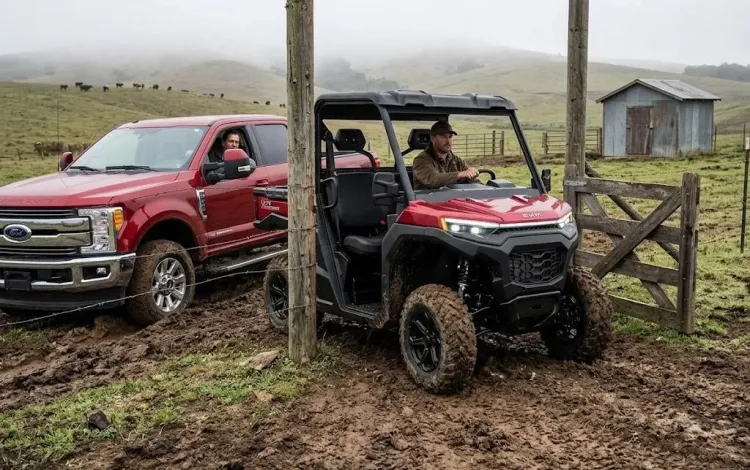 Is a Side-by-Side Considered a Motor Vehicle in the US?
Is a Side-by-Side Considered a Motor Vehicle in the US?
Is a Side-by-Side Considered a Motor Vehicle in the US?
-
Oct 22 2026
learn more
 How Much Does a 4-Seater Side-by-Side Weigh for SWM UTV?
How Much Does a 4-Seater Side-by-Side Weigh for SWM UTV?
How Much Does a 4-Seater Side-by-Side Weigh for SWM UTV?
-
Oct 23 2026
learn more
 How to Plan a Weekend ATV Adventure
How to Plan a Weekend ATV Adventure
How to Plan a Weekend ATV Adventure
-
Oct 20 2026
learn more
 ATV vs UTV for Snow Plowing: 5 Key Differences
ATV vs UTV for Snow Plowing: 5 Key Differences
ATV vs UTV for Snow Plowing: 5 Key Differences