UTV Tire Pressure: How Much PSI Should You Run?
Sep 21 2026
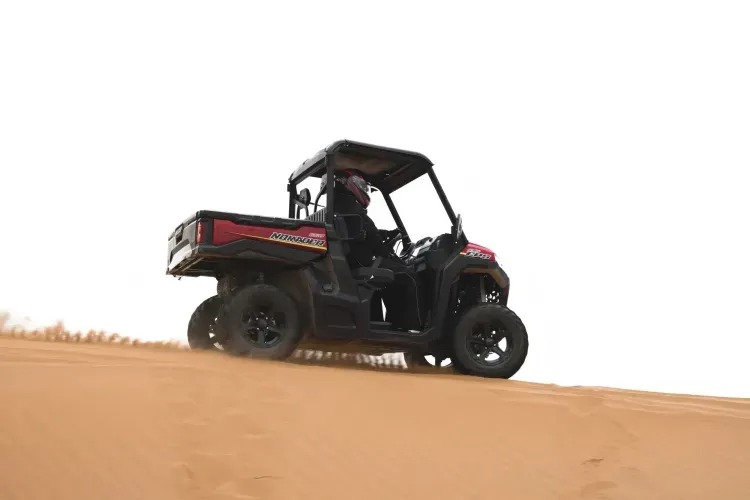
For utv tire pressure, there’s no magic PSI that works on every UTV or every ride. You have to start with what the vehicle maker and tire maker recommend, then adjust from there for terrain, tire type, load, and the way you actually ride.
On normal off-road terrain, you should not directly copy the tire pressure from another model. In soft terrain such as sand, tire pressure adjustments become even more noticeable, because the size of the tire’s contact patch affects how the vehicle performs on soft ground.
Therefore, instead of memorizing a fixed number, it is better to first understand how tire pressure should be determined, why different terrains require different adjustments, and when tire pressure should be rechecked.
What PSI Should a UTV Tire Have?
The safest starting point? The pressure specs from the UTV manufacturer and the tire manufacturer. UTV models can differ a lot in tire size, weight, and intended use, so copying the PSI from another machine is a gamble.
If the vehicle itself has a tire pressure label, check the pressure according to the label. You can also refer to the owner’s manual for the corresponding model and the tire manufacturer’s recommendations.
For normal trail riding, it is also not recommended to directly copy a common PSI range found online. Different UTVs may have different weights, tire sizes, tire constructions, and actual loads, so the same tire pressure will not necessarily suit every vehicle.
If you are performing routine UTV maintenance, tire pressure should also be checked together with tire wear, tire appearance, and other basic checks.
UTVs also run in very different environments and use very different tire designs. That’s why the recommendation for your exact vehicle and tire should come first.
How Does UTV Tire Pressure Affect Your Ride?
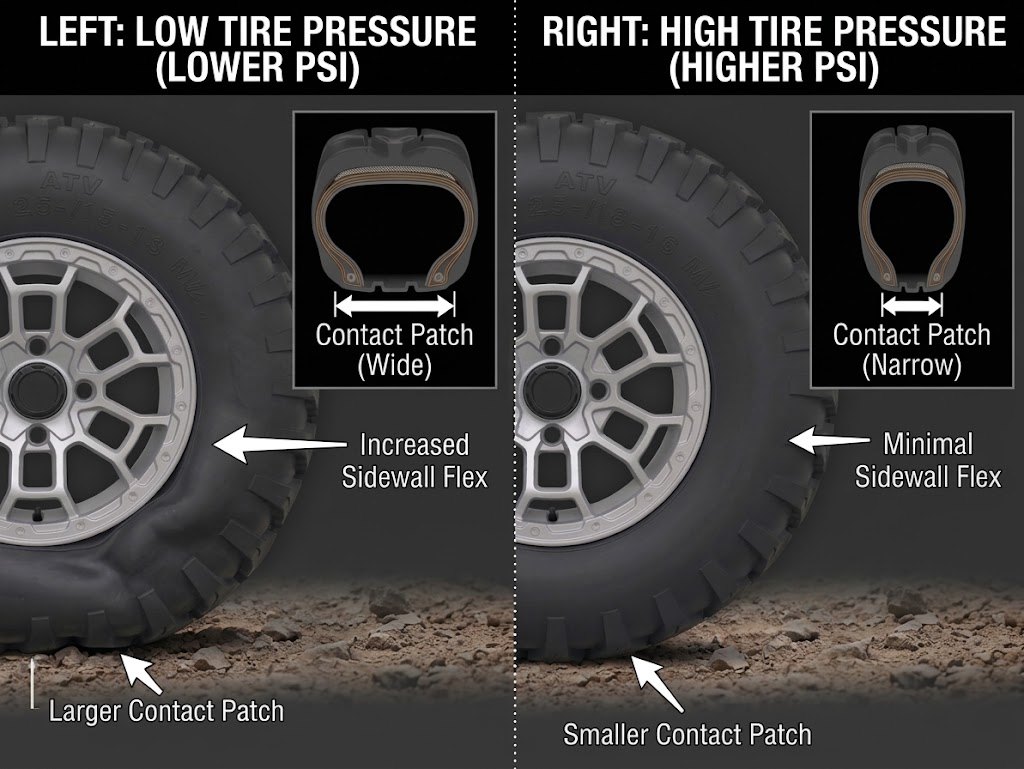
Tire pressure changes how much the tire flexes and how much of it actually touches the ground. That affects traction, flotation, and comfort on whatever surface you’re on.
Tire Pressure | Possible Changes | Issues to Watch |
Lower Tire Pressure | The tire becomes softer, contact area may increase, and sidewall flex increases. On soft terrain, this helps improve flotation. | Higher risk of bead de-seating, pinch flats, and rim damage if pressure drops too far. |
Higher Tire Pressure | The tire becomes firmer and sidewall flex decreases for sharper steering response. | On soft terrain, contact area decreases, traction drops, and the ride feels harsher. |
Lower UTV Tire Pressure
When you lower utv tire pressure, the tire deforms more and may create a larger contact patch.
This change is especially important in soft terrain. Tire technical information shows that lower inflation pressure can work with a larger contact patch, spreading weight over a larger area and improving flotation on soft ground.
But this does not mean lower is always better.
If tire pressure drops too far, the tire sidewall will undergo more deformation, and the fit between the tire and wheel/rim may also be affected. Therefore, lowering tire pressure should be based on the vehicle, tire, and specific terrain, not simply on chasing the largest possible contact patch.
Higher UTV Tire Pressure
Increasing tire pressure usually makes the tire firmer and reduces sidewall deformation.
On harder surfaces, this state may be more suitable. But if you continue into soft environments such as sand, excessively high tire pressure may limit the tire’s ability to form a larger contact patch.
So tire pressure is not a simple relationship where higher is safer or lower always gives more traction. It needs to be considered together with the actual terrain.
UTV Tire Pressure by Terrain
Different terrains place different demands on tires, so tire pressure should never be completely fixed.
Trail Riding
Normal trail riding doesn’t call for the low pressures you’d use in sand.
If you’re mostly on hard dirt, forest trails, or a mix of off-road surfaces, start with the vehicle manufacturer’s recommendation and adjust for load and real conditions.
If the terrain changes a lot—say, from packed dirt into deep sand—don’t just keep the same pressure all day. Recheck it and adjust.
Therefore, for trail riding, the vehicle and tire manufacturer’s recommended values should serve as the baseline, not a generic PSI number from the internet.
Sand Riding
Sand is a classic case where pressure really matters. On soft sand, lower pressure lets the tire spread out and build a bigger contact patch, which helps the UTV float instead of digging in.
The specific numbers depend on the vehicle and tire configuration. For example, when running specialized sand tires:
l UTV rear paddle tires: Reference range of 6–10 PSI
l UTV front ribbed tires: Reference range of 8–12 PSI
Front and rear tires do not necessarily use the same pressure. Different tires have different constructions and roles, so actual settings should differ between axles.
Note: SWM sand guidance reminds users to air back up before entering hard surfaces and recommends always carrying a portable inflation device.
Hard-Packed Roads & Pavement
After entering hard-packed roads or pavement, you should not continue using the low tire pressure set specifically for soft sand.
For example, if the vehicle has just completed a sand ride and the tires are at a lower pressure, you should recheck tire pressure before moving onto hard surfaces.
The point is not to chase a particular fixed PSI, but to bring tire pressure back into a range suitable for the current surface and vehicle.
If a day’s route includes sand, hard-packed dirt, and pavement, rechecking tire pressure when transitioning between different surfaces is more reasonable than sticking to one fixed number for the entire ride.
Mud and Rocky Terrain
Mud and rocky surfaces should also not simply copy sand tire pressure.
Mud places more emphasis on whether the tire can maintain enough traction, while rocky terrain requires consideration of both sidewall deformation and the impact from the surface on the tire and wheel/rim.
Therefore, for these terrains, it is still recommended to start with the vehicle and tire manufacturer’s recommended values, then adjust based on the actual environment.
If there are no clear manufacturer recommendations, do not directly copy the same setting just because another UTV used lower tire pressure in a certain terrain.
When Should You Check UTV Tire Pressure?
Tire pressure checks should not be done only when the tire feels abnormal.
Before Every Ride
Before you leave, checking pressure is one of the basic pre-ride checks. While you’re at it, look over the sidewalls and tread for cuts, punctures, or anything that looks off.
If a tire is clearly low or damaged, don’t just air it up and call it good. Figure out why it’s low or damaged first.
When the Terrain Changes
If a day’s riding route includes multiple terrains, tire pressure checks become even more important.
For example, after moving from a hard trail into sand, you can consider adjusting tire pressure based on the vehicle, tires, and manufacturer recommendations. When returning from sand to hardpack or pavement, you should recheck tire pressure.
This is also why a fixed PSI should not be treated as the answer for all riding environments. The correct tire pressure depends on where you are riding now, not just on what UTV model you have.
After Adjusting the Pressure
After sand riding—especially if you aired down—check the pressure again before you leave the sand. If you carry a portable inflator, switching pressures between terrains is a lot easier.
Common UTV Tire Pressure Mistakes
1. Using Car Tire Pressure
This is a common mistake.
Passenger cars and UTVs differ in tire size, construction, load, and operating environment. Therefore, you cannot assume that a UTV should use the same pressure just because a car tire uses a certain PSI.
You should prioritize the manufacturer’s recommendations for the corresponding UTV and tire.
2. Using the Same PSI for Every Terrain
The same tire pressure does not necessarily suit every terrain.
Sand and hard surfaces have clearly different requirements, while complex terrains such as mud and rocks also have their own characteristics.
Therefore, if the vehicle frequently switches between different terrains, tire pressure checks should be included in pre-ride and post-ride preparation.
3. Dropping the Pressure Too Far
Lowering tire pressure does not mean lowering it indefinitely.
Appropriately reducing pressure can increase tire deformation and contact patch, but if pressure is too low, it may also increase sidewall deformation and the risk of tire debeading.
Especially without clear manufacturer guidance, it is not recommended to air down arbitrarily and significantly just to chase a larger contact patch.
4. Checking Pressure Only After Riding
Checking tire pressure after riding has some value, but it cannot replace checking before departure.
If tire pressure was already low before departure, discovering the problem after the ride is too late.
A more reasonable approach is:
Check before departure;
Reconfirm when the terrain changes significantly;
Check again after airing down or airing up;
After finishing a sand ride, recheck before entering hard surfaces.
5. Forgetting to Air Back Up
This is especially easy to overlook during sand riding.
After lowering tire pressure to adapt to soft sand, do not assume that this pressure can be maintained indefinitely.
When the route returns to hardpack or pavement, recheck and restore the appropriate tire pressure according to the vehicle and tire requirements.
Final Thoughts
There is no single utv tire pressure that works for every ride.
A more reasonable approach is to first refer to the vehicle and tire manufacturer’s recommendations, then adjust according to terrain, tire type, and actual operating conditions.
In actual use, tire pressure also needs to be judged together with the specific vehicle and tire configuration. For example, the front and rear tire sizes of the NOMADER 850 are not the same, so when setting tire pressure, you should also base it on the requirements of the corresponding model and tires.
For everyday riding, what really matters is building a simple habit: check before departure, reconfirm after terrain changes, and remember to air back up to the appropriate pressure after airing down.
-
Sep 21 2026
learn more
 How Much Snow Can a UTV Side-by-Side Plow?
How Much Snow Can a UTV Side-by-Side Plow?
How Much Snow Can a UTV Side-by-Side Plow?
-
Sep 21 2026
learn more
 UTV Tire Pressure: How Much PSI Should You Run?
UTV Tire Pressure: How Much PSI Should You Run?
UTV Tire Pressure: How Much PSI Should You Run?
-
Sep 21 2026
learn more
 How Cold Weather Affects ATV Performance
How Cold Weather Affects ATV Performance
How Cold Weather Affects ATV Performance
-
Sep 20 2026
learn more
 How to Read ATV Tire Size: 27×9-14 Explained
How to Read ATV Tire Size: 27×9-14 Explained
How to Read ATV Tire Size: 27×9-14 Explained